
The hidden landmines in a procurement platform.
The wait on every revision. Classification typed by hand. The abbreviation you re-teach each month. The quote parked in someone's queue. Labor rates quietly overridden.
None show up in a demo. All show up in your week. Every one is measurable on a BOM you already have.
Does this describe your quoting week?
Not a list of things wrong with any one product. A list of things that are simply normal in this category, and expensive once you add them up.
- You wait minutes for a BOM to price, then wait the same minutes again when the customer sends a revision.
- You re-teach the system the same manufacturer abbreviation you already taught it last month.
- Your labor rates came from an industry benchmark, and your estimator quietly overrides them on every job.
- Somebody classifies components by hand, line by line, before attrition will calculate at all.
- A quote sits waiting in someone else's queue, and that someone is sitting ten feet away from you.
- You price a multi-layer BOM one level at a time and never see what the combined quantity would have reached.
If three or more of those landed, the rest of this page is about the difference, and every one of them is measurable on a BOM you already have.
Four differences, before the detail.
Under a minute
Not a list of things wrong with any one product. A list of things that are simply normal in this category, and expensive once you add them up.
Zero fields
Component classification you have to enter before attrition calculates. It is derived from package code and unit price.
One screen for all three
No role gates between engineer, purchaser and estimator. Everyone works the same quote at the same time, so there is no handoff to wait on.
14-30 days
Average implementation window, with one named person running it. Free trial on your own BOMs first.
The same part, three levels, three separate price breaks.
Where an identical orderable part number repeats across levels of an assembly, most platforms price it level by level, so each instance reaches its own break and the assembly never claims the quantity it actually buys.
Breadboard adds them together to reach the higher break, and shows you the source lines so you can check the arithmetic. Same manufacturer and same orderable part number only; packaging variants stay separate.
Test it on a BOM you already priced.
Pick one common passive that repeats across levels. Add the quantities by hand and find the break the total would have reached. The gap between that and the breaks each instance actually reached is money that was always available and never claimed.
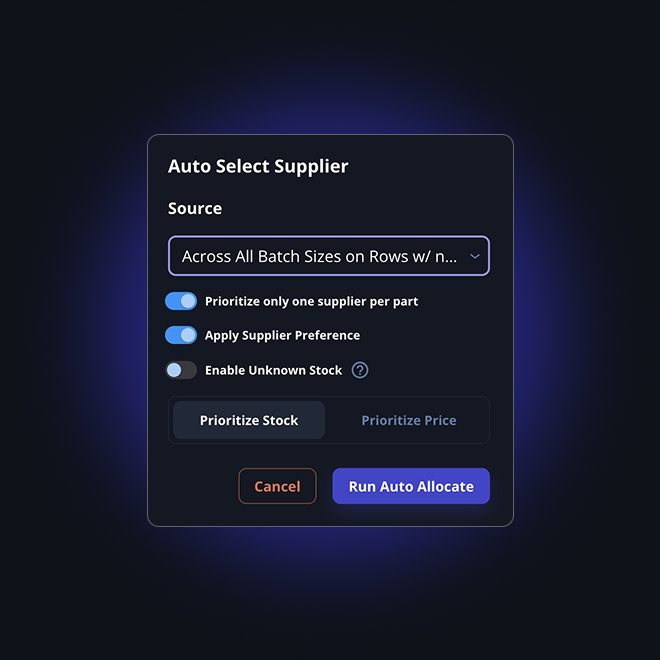
Illustrative quantities on a real orderable part number. Breaks shown are quantity tiers, not prices; the saving depends on your supplier set on the day you quote.
Six tests you can run this afternoon.
Every one of these runs on the platform you already have. None of them need us, and none of them need a demo booked three weeks out.
Time to priced lines
Take the messiest real BOM your team handled last month. Upload it to the platform you use today and time it from upload to priced lines.
You now have a number that no vendor gave you. Everything else gets easier to judge once it exists.
Repeated parts across levels
Price a multi-layer BOM where you know a common passive repeats. Check the break each instance reached, then add the quantities by hand and check what the total would have reached.
The gap between those two numbers is the saving currently going unclaimed.
Classification and mapping
Upload a real BOM and count the fields you had to fill before you saw a price. Then upload the same file again and count how many you had to fill a second time.
Those two counts describe your week better than any feature list.
Concurrent work
Ask two people to open the same quote at the same time and try to work on it.
A thirty-second test, and the answer is often different from the one on the feature list.
The labor model
Ask where the labor rates and times came from. If the answer is an industry standard, ask how your estimator adjusts it and who maintains those adjustments.
This is usually where the tribal knowledge is hiding.
Implementation
Ask any vendor which part of the migration takes longest and why. If they cannot answer specifically, they have not done many.
The honest answer is almost always the labor model, because part of it lives in someone's head.
Send us one real BOM. We price it live, with the clock on screen.
You keep the priced output and you keep the recording. Then you run the same file through the platform you use today and time it yourself. We do not make the comparison and we do not need to see your result. You produce the number, on your own data, and whatever it says is true in a way no marketing page can be.
About twenty minutes including questions. No pricing conversation attached and no contract.
About your file, before you have to ask.
A bill of materials is competitively sensitive and you should be careful who you send one to. So, plainly: we price the file, we show you the result, and that is all we do with it. We do not share it, we do not use it to train anything, and we delete it on request at any point without you having to give a reason. An NDA is available before you send anything.
If you would rather keep the part numbers to yourself, send a redacted BOM. Quantities and package codes are enough to show you what you need to see. We never touch your systems, your ERP or your current platform. We read only the file you choose to send.
Designed and built with❤️ in NYC
Copyright 2025 © All rights reserved

Disclaimer
Performance figures, benchmarks, win-rate ranges, and ROI examples in these materials are illustrative. They reflect industry research, aggregated customer data, and modeled scenarios, and are provided to explain how quote speed can affect competitive outcomes. They are not a promise or guarantee of specific results. Actual results depend on your bill of materials, data quality, sourcing conditions, market pricing, and how your team uses the platform, and they will vary.
The 60-Minute Quote Challenge returns a complete, priced quote in 60 minutes or less for most submitted BOMs. Completion time depends on BOM size, complexity, file format, and data completeness. Some BOMs, including those with significant custom, proprietary, or engineering-dependent content, require additional time. Where that happens, Breadboard explains the exceptions and delivers the remaining quote.
Third-party company, product, and platform names are the property of their respective owners and are used for identification and comparison only. Comparisons rely on publicly available information believed accurate as of the campaign date and do not imply affiliation, sponsorship, or endorsement. Breadboard is a mark of EETech.