Quoting Platform for Electronics Manufacturing Services Companies (EMS): A Strategic Guide to Accelerating PCBA Growth
Executive Summary
For leaders in the Electronics Manufacturing Services (EMS) industry, the landscape has fundamentally shifted. Intense global competition, persistent supply chain volatility, and increasing customer demands for speed have rendered traditional quoting and sourcing methods obsolete. Processes reliant on spreadsheets and fragmented communication are no longer just inefficient; they are a direct threat to profitability, scalability, and market share. This whitepaper presents a strategic framework for transforming your quoting process from a costly bottleneck into a powerful engine for growth.
We will explore the quantifiable impact of adopting a modern, AI-powered EMS quoting platform for electronics. By examining the limitations of manual processes and legacy software, this paper will demonstrate how top-tier EMS companies like Sonic Manufacturing Technologies, Lonestar EMS, and Volex are leveraging Breadboard to achieve unprecedented results:
- Up to an 80% reduction in the time required to generate complex PCBA quotes.
- A 12% or greater increase in quote-to-win rates.
- Over 250X Return on Investment (ROI) within the first year.
- Seamless adoption and full customization within two weeks, a fraction of the time required by legacy systems.
The central thesis is clear: speed and ease of use are the new currencies in electronics manufacturing. An EMS provider’s ability to deliver fast, accurate, and competitive quotes is the single most critical factor in winning business and achieving sustainable growth. This document provides the blueprint for C-suite executives to lead that transformation.
Introduction: The Modern EMS Imperative – Speed, Accuracy, and Resilience
The global PCBA market is projected to reach nearly $80 billion by 2025, but this growth is fraught with challenges. The "Golden Screw" problem—where a single missing component can halt a multi-million dollar production line—has become a daily reality. Customers now expect quotes not in weeks, but in days or even hours. Meanwhile, experienced procurement specialists are retiring, creating a knowledge gap that manual processes cannot bridge.
In this environment, the traditional RFQ process has become the epicenter of operational risk. A workflow dependent on spreadsheets, endless email chains, and manual data entry is inherently slow, error-prone, and impossible to scale.
The Failure of Traditional Methods:
- Speed Deficit: Manual BOM scrubbing and component sourcing can take days or weeks, causing potential customers to move on to more agile competitors. Industry analysis shows that many EMS companies can only respond to 60% of incoming RFQs due to these capacity constraints
- Accuracy Risk: Spreadsheets are susceptible to human error, outdated pricing, and "formula rot." Miscalculating material costs—which can account for over 70% of a PCBA's total cost—directly erodes profitability or leads to uncompetitive, overpriced bids.
- Scalability Ceiling: Growth becomes capped by headcount. To increase quoting capacity, a company must hire more specialists, a costly and often unsustainable model.
- Data Voids: Static data provides no defense against market volatility. Without real-time visibility into component pricing, stock, lead times, and lifecycle status, every quote is a gamble.
Legacy SaaS platforms attempted to solve these issues but often introduced new complexities: rigid workflows, lengthy implementation cycles, and a user experience that failed to match the dynamic nature of modern sourcing. The market needs a new approach—one built for speed, simplicity, and strategic impact.
Chapter 1: The High Cost of Inefficiency – Deconstructing the Manual Quoting Process
To appreciate the transformative power of automation, it's essential to dissect the hidden costs of the status quo. Research shows that procurement engineers can spend up to 159 hours per year on purely administrative BOM tasks. When scaled across a team, this represents a significant drain on strategic resources.
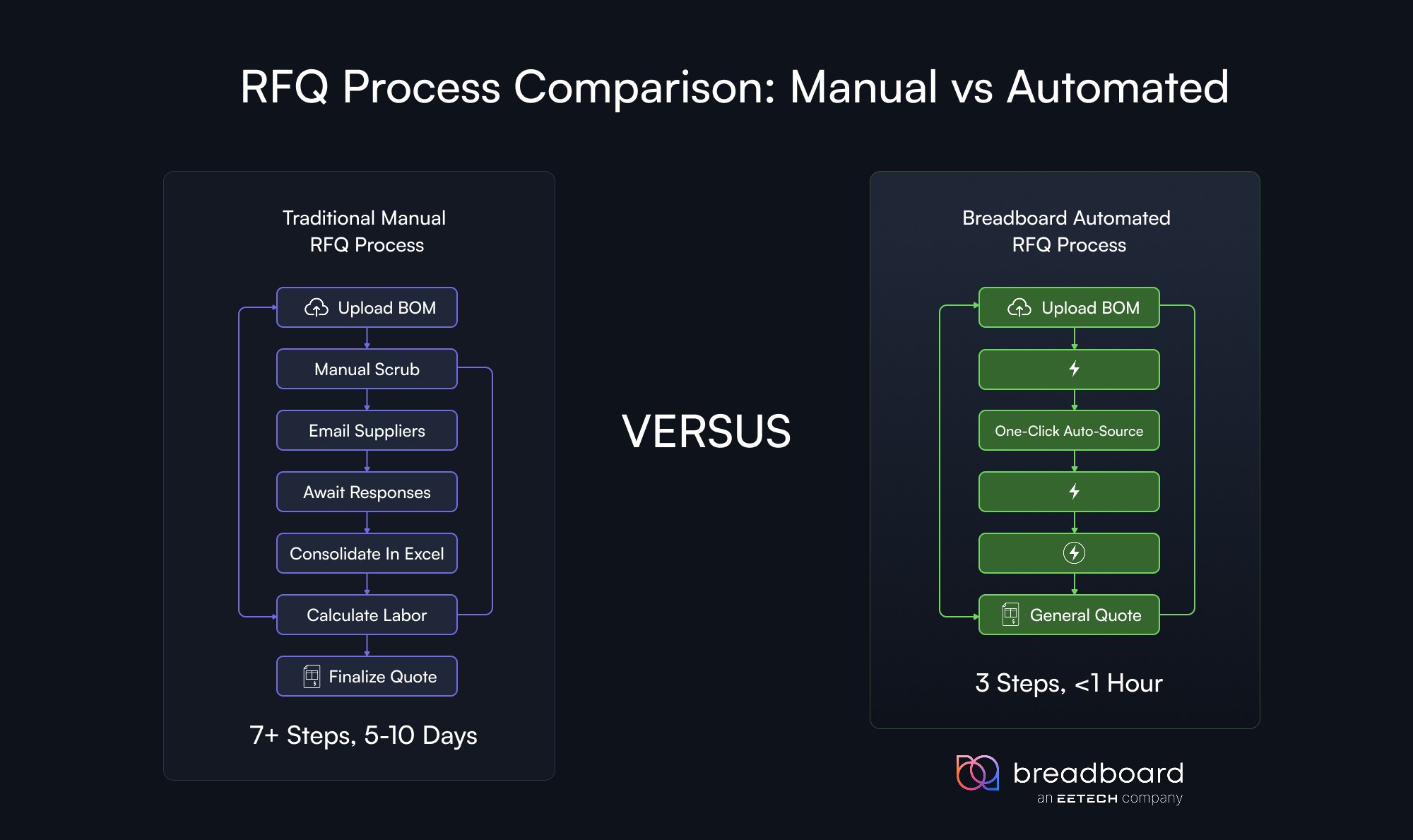
A typical manual RFQ workflow for a PCBA project involves a painstaking sequence of events:
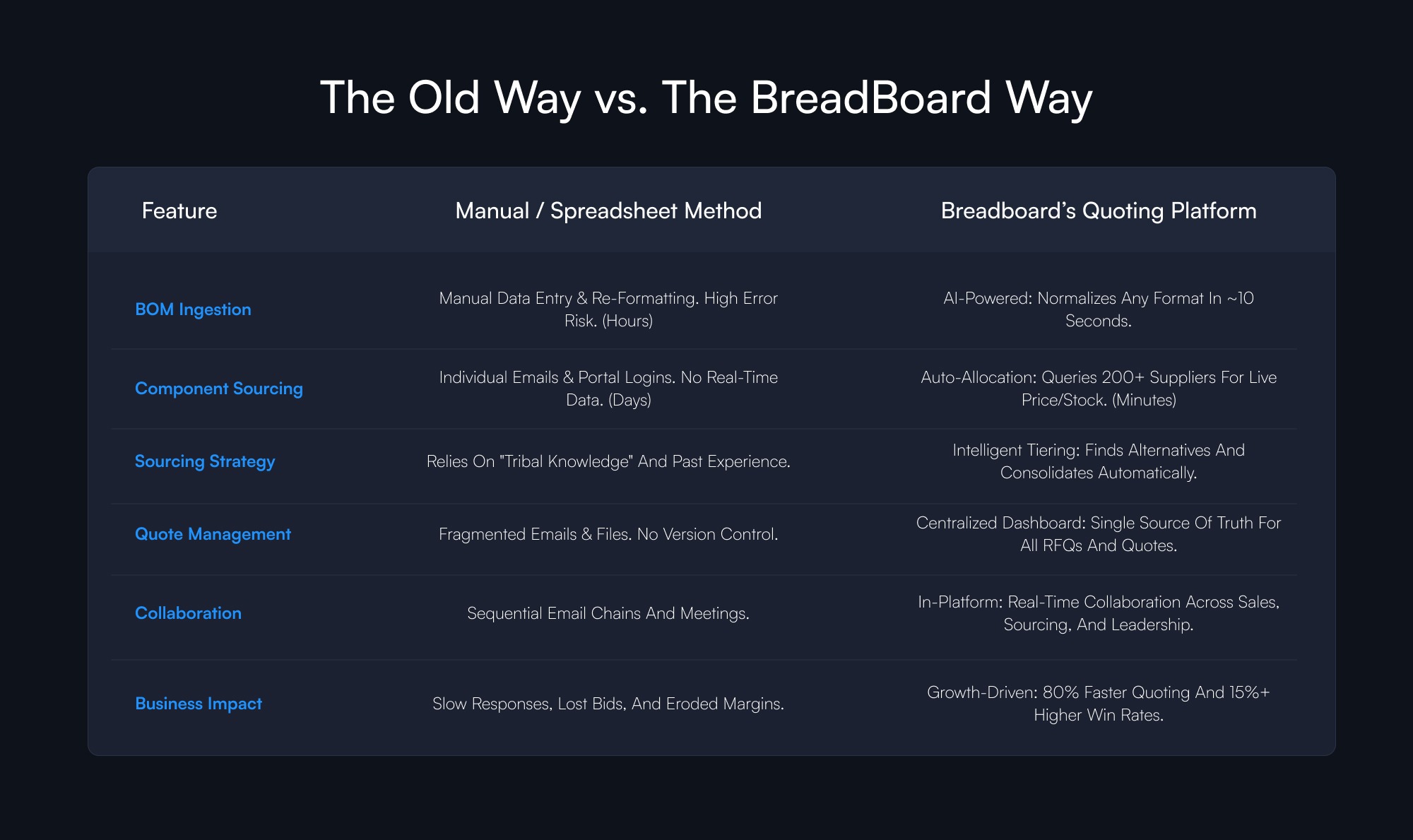
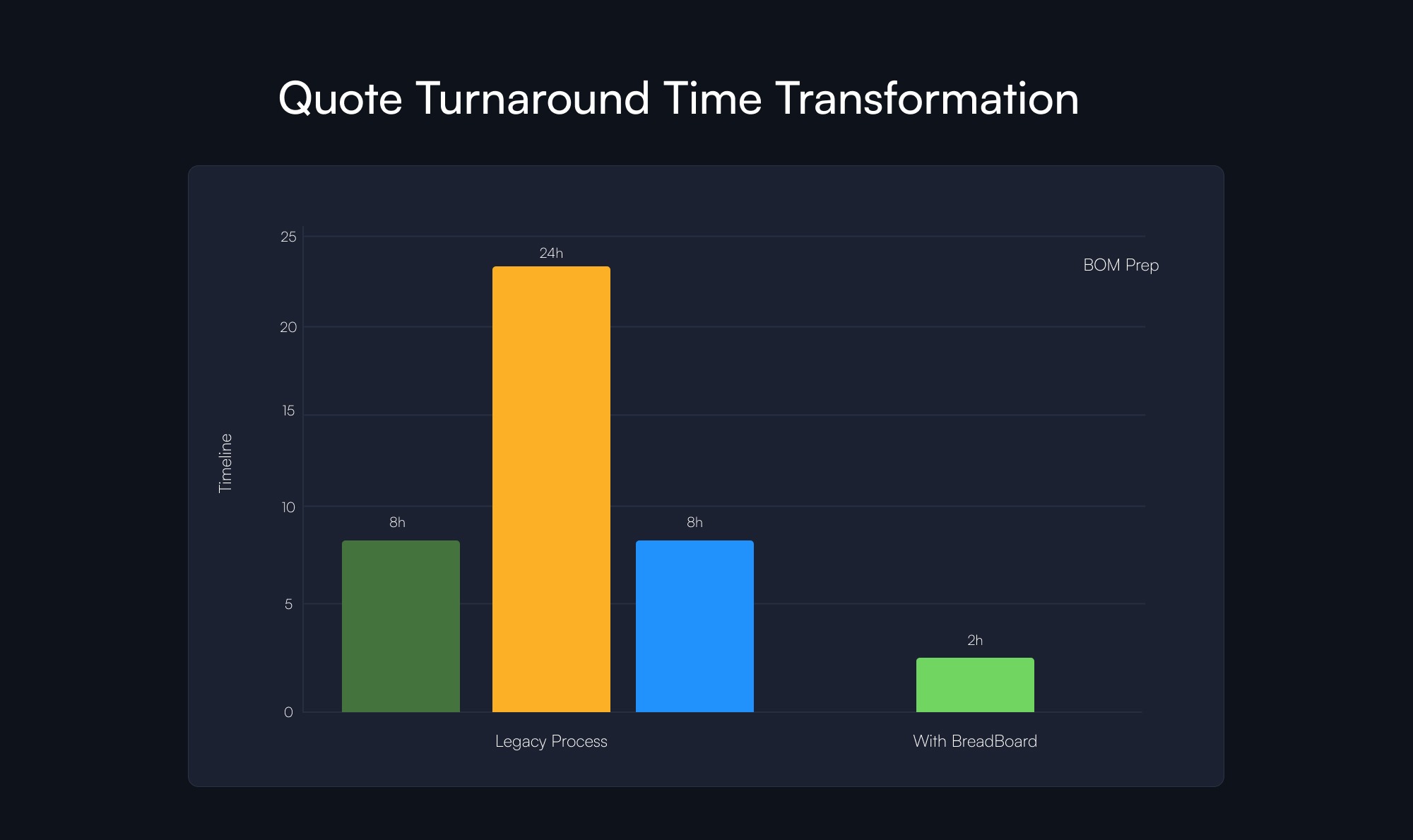
- BOM Ingestion & Normalization: A customer submits a BOM, often in a non-standard format. A quoting specialist must manually re-format the data, correct part numbers, and validate descriptions. (Time: 2-8 hours)
- Component Sourcing: The specialist sends dozens of individual emails or logs into multiple distributor portals to check price and availability for each line item. (Time: 8-24 hours)
- Data Consolidation: Responses trickle in via email. The specialist must manually copy-paste pricing, lead times, and MOQs into a master spreadsheet, a process highly prone to error. (Time: 4-10 hours)
- Labor & Overhead Calculation: Using another spreadsheet, labor costs are calculated and added to the material costs. (Time: 1-2 hours)
- Quote Generation & Review: The final quote is manually compiled into a branded template and sent for internal review before reaching the customer. (Time: 2-4 hours)
Total Time Elapsed: 17-48+ hours, often spanning several days.
This process is not only slow but also opaque. There is no centralized data, no easy way to track supplier performance, and no mechanism to quickly find alternative parts in a shortage. Every quote is a ground-up effort that fails to build institutional knowledge.
The Old Way vs. The Breadboard Way
Chapter 2: Redefining Speed and Simplicity in PCBA Quoting
The core philosophy behind Breadboard is that the most powerful platform is one that is both fast and intuitive - easy to use. Top EMS partners adopt and master Breadboard within two weeks not because it’s a simpler tool, but because it’s a smarter one. It automates the tedious work and empowers the scale of quote throughput.
Unprecedented Speed: From Days to Minutes
Breadboard’s architecture is engineered to eliminate waiting. This is achieved through three key innovations:
1. AI-First Data Ingestion: The platform's ability to take a "dirty" BOM in any format and structure it into actionable project data in approximately 10 seconds is faster than any industry standard. This immediately removes the most time-consuming manual step in the process.
2. One-Click Auto-Allocation: Instead of sequential RFQs, Breadboard’s engine sources an entire BOM across over 200 global suppliers at once. It intelligently allocates parts based on user-defined strategies - lowest price, fastest availability, or supplier consolidation - delivering a fully costed BOM in minutes, not days.
3. Instant Quote Import: For components requiring manual bids or special negotiations, Breadboard’s AI can ingest a fully quoted supplier file in seconds. This eliminates hours of manual data entry when dealing with non-API suppliers, seamlessly blending automated and manual sourcing.
Case Study:
A leading global manufacturer was bogged down by a quoting process that took an average of 15 days. After implementing Breadboard, they reduced their average quote time to under 24 hours, a 93% improvement that transformed their sales cycle and competitive positioning.
"Breadboard gives me confidence, knowing that my pricing is accurate and competitive in current market conditions. It is more user-friendly than any competitor I've seen and allows users to view the full scope of their project while also providing detailed information on individual line items." — Customer, Quoting Manager, UK Manufacturing Company
Radical Ease of Use: Adoption in Two Weeks
Technology is only effective if people use it. Breadboard’s rapid adoption is driven by a focus on workflow integration and user experience:
- Intuitive UI: The platform is designed for quoting and procurement professionals, not IT experts. It mirrors the logical flow of the quoting process, making it easy for new users to become productive immediately.
- Seamless Onboarding & Customization: The two-week adoption cycle includes dedicated training and complete customization of critical outputs like labor unit exports, branded quote templates, and the integration of negotiated pricing APIs from preferred suppliers. Breadboard adapts to your business, not the other way around.
- A True Partnership: With an average customer support response time of 45 seconds, the Breadboard team acts as an extension of your own. This high-touch support model ensures questions are answered instantly and obstacles are removed, fostering user confidence and platform mastery.
Chapter 3: From Quoting Tool to Strategic Growth Engine – The ROI of Automation
For the C-suite, speed and simplicity are means to an end. The ultimate goal is profitable, sustainable growth. Breadboard is designed to deliver tangible business outcomes that directly impact both the top and bottom lines.
Increased Win Rates and Revenue Growth
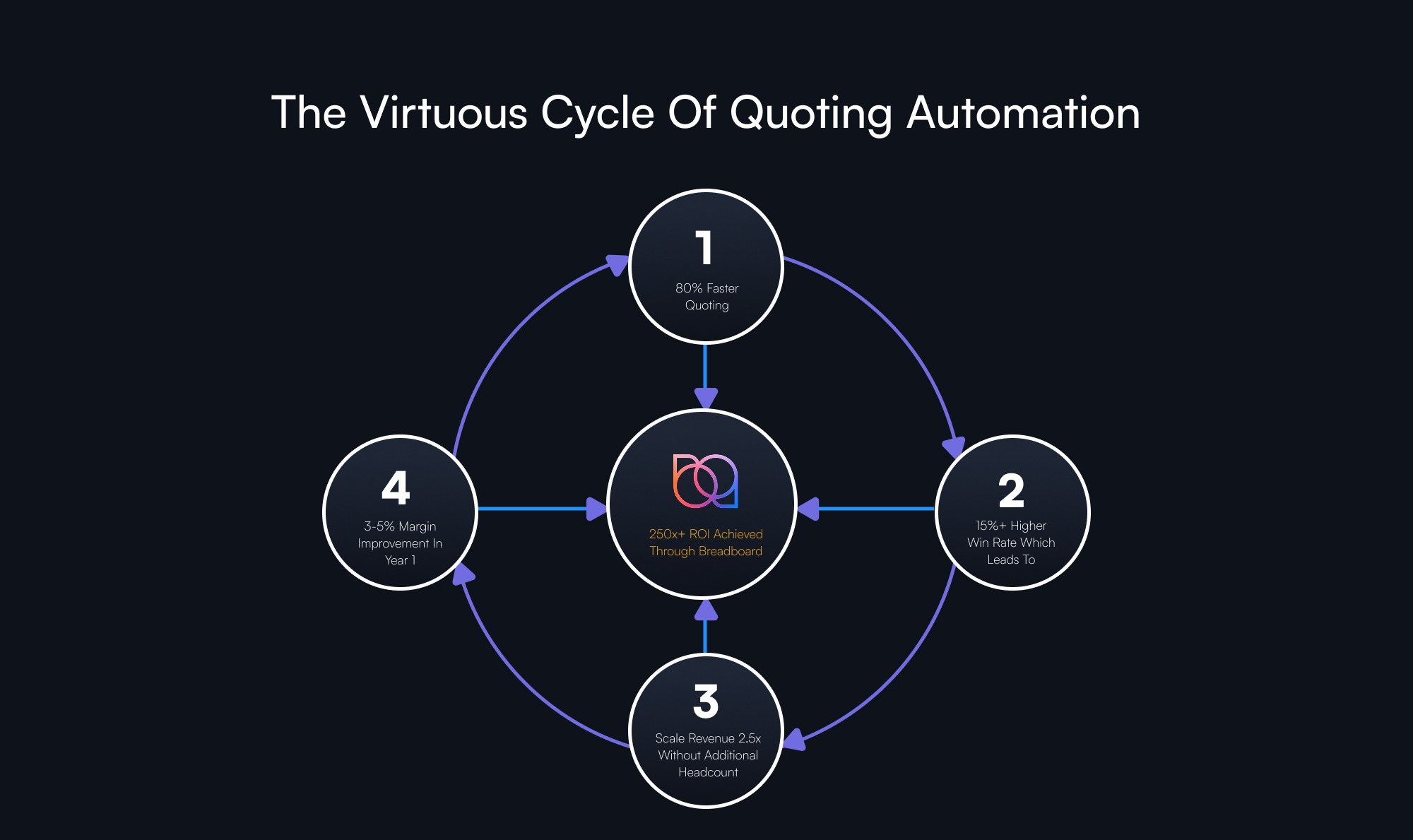
In a competitive bid situation, the first comprehensive and professional quote often wins. By reducing quote time by up to 80%, Breadboard enables EMS partners to be more responsive, bid on more opportunities, and ultimately increase their booking rates by 15% or more.
Case Study: Lonestar EMS
Lonestar EMS leveraged Breadboard to cut their quote time by 67%. This newfound efficiency allowed them to handle 2.5 times their previous quote volume without adding a single person to their headcount, directly translating operational efficiency into scalable revenue growth.
"Breadboard has transformed our quoting process from a bottleneck into a competitive advantage—improving speed, accuracy, and customer confidence while directly contributing to top-line growth." — Mary Sommer, COO, Lonestar EMS
Improved Profit Margins and Cost Control
The platform’s real-time sourcing and purchasing for electronics capabilities provide a powerful defense against margin erosion.
- Component Cost Savings: By analyzing offers from over 200 suppliers simultaneously, Breadboard consistently identifies cost-saving opportunities, delivering an average of 3-5% savings on total component spend.
- Risk Mitigation: The platform automatically flags problem parts - obsolete, non-compliant, or at risk of shortage - allowing procurement teams to find verified alternates before they impact production and lead to costly spot buys.
The 250X ROI: A Strategic Investment
The combination of increased revenue, improved margins, and operational scalability culminates in a powerful financial return. Partners who fully leverage the Breadboard platform have reported a 250X+ return on their investment in year one. This isn't just a software upgrade; it's a fundamental shift in the business model, turning a cost center into a strategic asset.
The Virtuous Cycle of Quoting Automation
Chapter 4: Why Legacy Platforms Fall Short
The need for a digital quoting solution is not new. However, first-generation legacy SaaS platforms have failed to keep pace with the market, often creating as many problems as they solve. EMS leaders frequently report frustrations with these systems, which suffer from three primary flaws:
1. Clunky, Manual Data Handling: Legacy systems lack the sophisticated AI to handle imperfect data. They require users to spend hours manually cleaning and formatting BOMs before the platform can even begin its work. This front-end inefficiency negates many of the potential downstream benefits. Breadboard’s AI-first approach solves this foundational problem.
2. Rigid, One-Size-Fits-All Workflows: Older platforms force businesses into a predefined process. They lack the flexibility to easily customize quote templates, labor calculations, or supplier integrations. This forces teams to create manual workarounds, defeating the purpose of an integrated system. Breadboard is built for customization from the ground up.
3. Slow, Impersonal Support: Legacy vendors often treat support as a low-priority service. When a critical quote is on the line, waiting hours or days for a support ticket response is unacceptable. Breadboard's model of dedicated, near-instantaneous support treats every customer as a strategic partner.
In essence, while legacy platforms digitized the spreadsheet, they failed to reinvent the process. Breadboard leverages AI and a user-centric design to deliver a truly transformative experience, focusing on the outcomes that matter most: speed, growth, and profitability.
Conclusion: The Future-Proof EMS is Built on Breadboard
The electronics manufacturing industry is at a crossroads. The companies that thrive in the coming decade will be those that replace antiquated, manual processes with intelligent, automated systems. The RFQ and quoting process represents the single greatest opportunity for achieving a decisive competitive advantage.
By embracing a platform that prioritizes speed and ease of use, EMS leaders can empower their teams to quote faster, win more business, and protect their margins in a volatile market. The proven results achieved by industry leaders like Volex, Sonic Manufacturing Technologies, and Lonestar EMS demonstrate that this is not a theoretical benefit—it is a practical, achievable reality.
The choice is no longer between a spreadsheet and a piece of software. It is between stagnation and growth, between reacting to the market and leading it. Breadboard provides the engine for that leadership.
Take the Next Step
See for yourself why the industry’s most respected EMS companies trust Breadboard to power their growth. Our team is ready to show you how our platform can be customized to meet your specific business needs and deliver a transformative return on investment.
We are more than a vendor; we are an extension of your team, committed to your success.
Request your personalized demo today and discover how you can scale your business with proven metrics and a partner you can count on.



.png)
Built for the Future Available Today
Designed and built with❤️ in NYC
Copyright 2025 © All rights reserved
